The civilizational volume · The Frame Shop
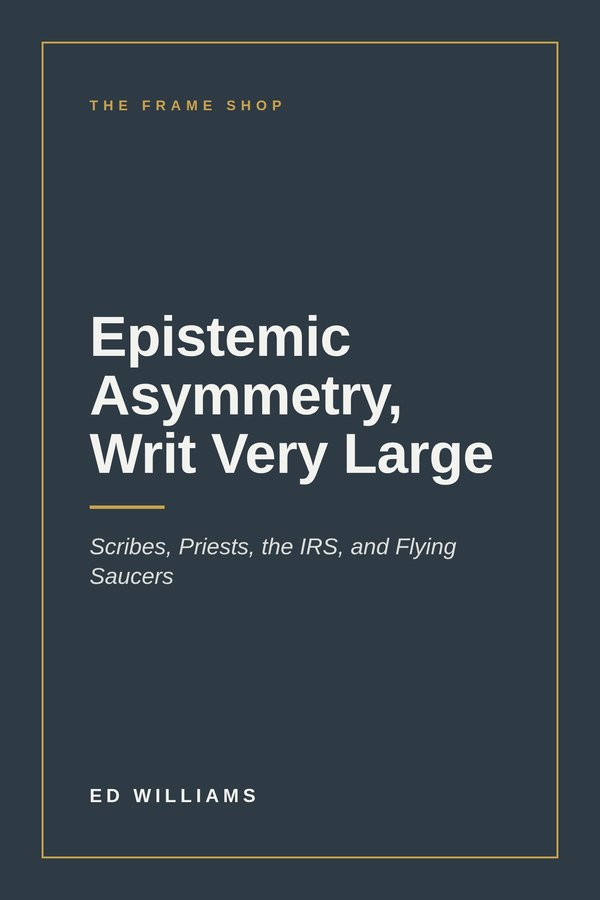
Epistemic Asymmetry, Writ Very Large
Scribes, Priests, the IRS, and Flying Saucers
Paperback shipped to you, plus the ebook now
Available soon. To reserve a copy, email info@theframeshop.co.
Want all three? See the trilogy offers.
Every durable knowledge gap produces someone who manages it.
That single observation runs through Epistemic Asymmetry, Writ Very Large. It begins with the first agricultural surplus, when a few people learned to count the grain and everyone else learned to trust the count. It then follows the same architecture forward: into temples that kept the records, councils that settled what would count as orthodox belief, professions that licensed who could speak with authority, and the algorithms that now decide, quietly and at scale, what most people see and know.
The same lens reaches subjects most serious books avoid, from the modern tax system to the official handling of unidentified flying objects. Both turn out to behave like every other managed knowledge gap. The point is never the scandal. It is the structure underneath it.
This is not a book about villains. Conspiracy thinking asks who is to blame. This book asks a more useful question: once a gap opens between those who know and those who don't, what keeps it in place? The answer is rarely a secret plot. It is structure: incentives, credentials, specialized vocabulary, and habits of deference that reinforce themselves long after anyone designed them.
Ed Williams gives readers a small set of diagnostic questions that work at any scale. Who benefits? Does the map still match the terrain? Does this arrangement affirm or deny human agency? Applied to history, the questions reveal patterns. Applied to the present, they reveal choices.
Written for general readers in plain language, the book treats its reader as fully capable of seeing clearly, and of deciding what to do with what they see.
Epistemic Asymmetry, Writ Very Large is the civilizational volume of a three-book series from The Frame Shop. What Is This "Knowledge Cycle"? lays out the framework underneath all three, and The Operating System No One Built takes the same question inside organizations. Each book stands on its own.